
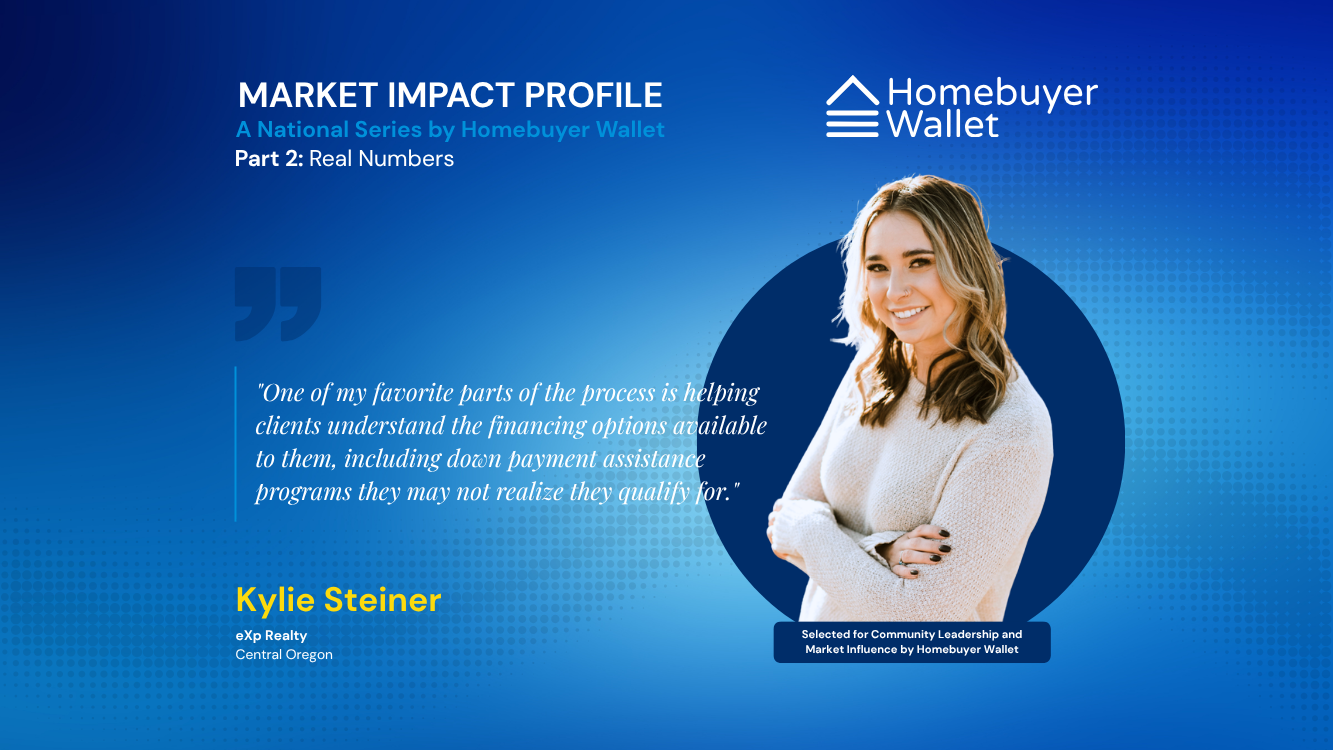
Realtor Kylie Steiner helps buyers across Central Oregon identify financing paths, lender strategies and assistance options that can reduce the upfront cash barrier to homeownership.
On a $450,000 home, a 20% down payment equals $90,000. At 3%, the down payment falls to $13,500 — a $76,500 difference before closing costs — and Kylie Steiner, a Realtor with eXp Realty serving Central Oregon, uses that kind of financing contrast to show buyers why they should understand their options before deciding homeownership is out of reach. Steiner estimates that down payments in her market can range from 3% to 20% depending on the buyer and loan structure, while qualified USDA and VA borrowers may have access to financing that requires no down payment.
That difference carries weight in Steiner’s typical $300,000-to-$700,000 buyer price range, where assumptions about the cash needed to close can affect how long someone believes they must continue saving before purchasing. “One of my favorite parts of the process is helping clients understand the financing options available to them, including down payment assistance programs they may not realize they qualify for,” Steiner said.
Financing Changes the Starting Number
Financing access means matching a buyer with a realistic loan and assistance path that reduces the cash barrier to purchasing without sacrificing financial comfort. For Steiner, that process starts by challenging the assumption that every buyer must arrive with a conventional-size down payment before beginning a serious home search.
The distinction becomes clearer when the loan options Steiner discusses are attached to their actual mechanics. The Federal Housing Administration, part of the U.S. Department of Housing and Urban Development, insures FHA loans that can allow a down payment as low as 3.5% of the purchase price on eligible one- to four-unit properties. At $450,000, 3.5% equals $15,750, which produces a very different savings target than $90,000 at 20%.
Steiner also works with buyers considering USDA financing, an especially relevant conversation in a Central Oregon practice that includes communities and rural properties outside the region’s larger population centers. The U.S. Department of Agriculture Rural Development Section 502 Single Family Housing Guaranteed Loan Program allows qualified borrowers purchasing eligible rural properties to receive 100% financing; applicants must satisfy income and other eligibility requirements, and the property itself must fall within an eligible rural area. Steiner’s role is not to declare that a house or borrower qualifies, but to get buyers into the lender conversation early enough to determine whether that route is available.
For eligible veterans, service members and certain surviving spouses, Steiner also points buyers toward VA financing. The VA Home Loan Guaranty benefit, administered by the U.S. Department of Veterans Affairs, does not itself require a down payment, although individual lenders can require one in some circumstances and borrowers still must satisfy eligibility, credit and income standards. That distinction reinforces Steiner’s broader strategy: the advertised home price alone does not reveal how much cash a particular qualified buyer will need to purchase it.
Pre-Approval Sets the Search Before Emotion Does
Steiner sees one mistake repeatedly: buyers begin looking at homes before they know what their financing supports. She reverses that order, making lender preparation part of the beginning of the property search rather than a step that comes after a buyer has already become attached to a house.
“Getting pre-approved early helps buyers understand their budget, strengthens their offers, and allows them to move quickly when the right property becomes available,” Steiner said. The value of that preparation is not merely knowing a maximum loan amount; it gives Steiner a financial boundary she can use when helping clients compare properties and decide how aggressively to negotiate.
That sequence matters in a region where Steiner’s buyers may be comparing very different types of properties across Madras, Culver, Redmond, Bend, Prineville, Terrebonne, Sisters and surrounding rural Central Oregon communities. A typical purchase is between $300,000 and $700,000 and includes everything from conventional single-family homes to properties with acreage, barns and shops, so a financing structure that works for one search may not work for another.
The lender conversation therefore becomes part of Steiner’s property strategy. She has said she values lending partners who educate clients, communicate proactively and coordinate with the other professionals involved, because the loan cannot operate separately from offer deadlines, inspections and closing requirements.
Oregon Assistance Can Address More Than the Down Payment
Steiner includes Oregon Bond loan programs and down payment assistance among the financing options she explores with eligible buyers. Today, Oregon Housing and Community Services offers Flex Lending, which includes two first-mortgage options — FirstHome and NextStep — that qualified borrowers can pair with the agency’s Down Payment Assistance program to help reduce the upfront cost of buying a home.
That current program structure illustrates why Steiner wants buyers to investigate assistance instead of making assumptions from a down payment percentage alone. Oregon Housing and Community Services states that Flex Lending down payment assistance funds may be used for up to 100% of a qualifying borrower’s cash requirement to close, including the down payment, closing costs, prepaid expenses, certain mortgage insurance costs and other eligible loan expenses. Eligibility and the amount available depend on the borrower and program rules, so Steiner’s strategy remains centered on connecting the buyer with a knowledgeable lender rather than promising a particular assistance figure.
Her value in this angle lies in making buyers ask the financial question early enough: What options actually apply to this borrower and this property?
“My goal is to make homeownership feel achievable by connecting buyers with trusted lenders and helping them navigate every step with confidence,” Steiner said. The operative word is “connecting.” Steiner brings financing into the real estate plan, then works alongside the lending side rather than treating mortgage selection as something outside her responsibility to help the buyer understand.
Closing Costs Create a Second Cash Hurdle
Reducing the down payment does not automatically solve the entire cash-to-close problem, and Steiner makes that distinction part of her buyer preparation. She estimates closing costs in Central Oregon at approximately 2% to 5% of the purchase price, depending on the loan, lender fees, title and escrow expenses, prepaid taxes and insurance, and whether the seller contributes toward those costs.
On the same $450,000 example, a 2% to 5% range represents approximately $9,000 to $22,500 in closing costs. A buyer who focuses only on obtaining a low down payment could therefore solve one upfront expense while remaining unprepared for another, which is why Steiner’s financing discussion has to account for the full amount required to reach closing.
Seller contributions can change that equation again. Steiner specifically includes seller-paid closing costs among the variables affecting what the buyer ultimately pays, making negotiation part of the affordability strategy rather than treating purchase price as the only financial term worth discussing.
The improving negotiating environment Steiner describes in Central Oregon gives that strategy additional relevance. She has seen buyers gain more choices and negotiating power compared with the highly competitive conditions of several years ago, which creates more room to consider terms alongside price when a particular property and seller allow it.
A La Pine Purchase Turned Uncertainty Into a Plan
Steiner saw the emotional side of financing uncertainty in her first real estate transaction, when she represented first-time homebuyers purchasing a single-family home in La Pine, Oregon, in the $350,000-to-$450,000 range. The buyers wanted to stop renting and begin building equity, but they entered the process unsure how financing worked, worried about making the wrong decision and uncertain whether they could successfully compete within their budget.
Steiner connected them with a trusted lender, explained each stage of the transaction and helped them understand what the market would allow within a budget they considered comfortable. When they found a property, she built the offer around comparable sales and the home’s value while preserving appropriate inspection and financing protections rather than encouraging the buyers to abandon safeguards simply to make the offer stronger.
“The goal wasn’t simply to buy a house — it was to purchase the right home at terms they felt comfortable with,” Steiner said. That principle distinguishes her version of financing access from an approach built around qualifying for the largest possible mortgage or minimizing the down payment at any cost.
Steiner did not specify which loan product those La Pine buyers ultimately used, their down payment percentage or whether they received financial assistance, so their purchase should not be presented as proof of a particular government program. What the transaction does show is her process: establish the budget, involve the lender, explain the financial decisions, preserve the buyer’s protections and keep the purchase aligned with terms the clients can accept.
The result was a shift in how the buyers viewed homeownership itself. “The moment they received the keys and told me they never thought homeownership would be possible was incredibly rewarding,” Steiner said. Their closing gave Steiner an early example of what can happen when uncertainty about financing is replaced with a defined plan.
Sustainable Access Matters More Than Maximum Approval
The strongest financial outcome in Steiner’s strategy is not the smallest possible down payment. It is reaching a purchase structure that allows a buyer to enter the market without turning loan eligibility into permission to ignore the rest of the household’s financial comfort.
That is why the $76,500 gap between 20% and 3% down on a hypothetical $450,000 purchase matters, but it is not the entire story. A lower down payment can shorten the savings timeline for a qualified buyer, while USDA or VA eligibility can change it further; closing costs, monthly payments, property expenses and financing protections still determine whether the transaction makes sense for that individual buyer. Steiner’s own $450,000 example places an estimated conventional monthly housing payment at roughly $2,800 to $3,500, including principal, interest, taxes and insurance, depending on the loan structure and interest rate.
Steiner’s approach keeps those numbers connected. She starts with financing before the home search, pushes buyers to understand multiple pathways, brings trusted lending professionals into the process, accounts for cash beyond the down payment and then evaluates the offer against the buyer’s comfort level.
For Central Oregon buyers who assume purchasing requires 20% down before they ever speak with a lender, that process can expose a very different starting point. Steiner’s market impact comes from helping buyers discover that possibility without presenting financing as a shortcut: the objective is not simply to find a way into a house, but to identify a financially workable path into the right one.
Want to connect with Kylie? You can follow her on Instagram, Facebook, Tiktok, or LinkedIn, visit his personal website for more details, or send her an email directly.