
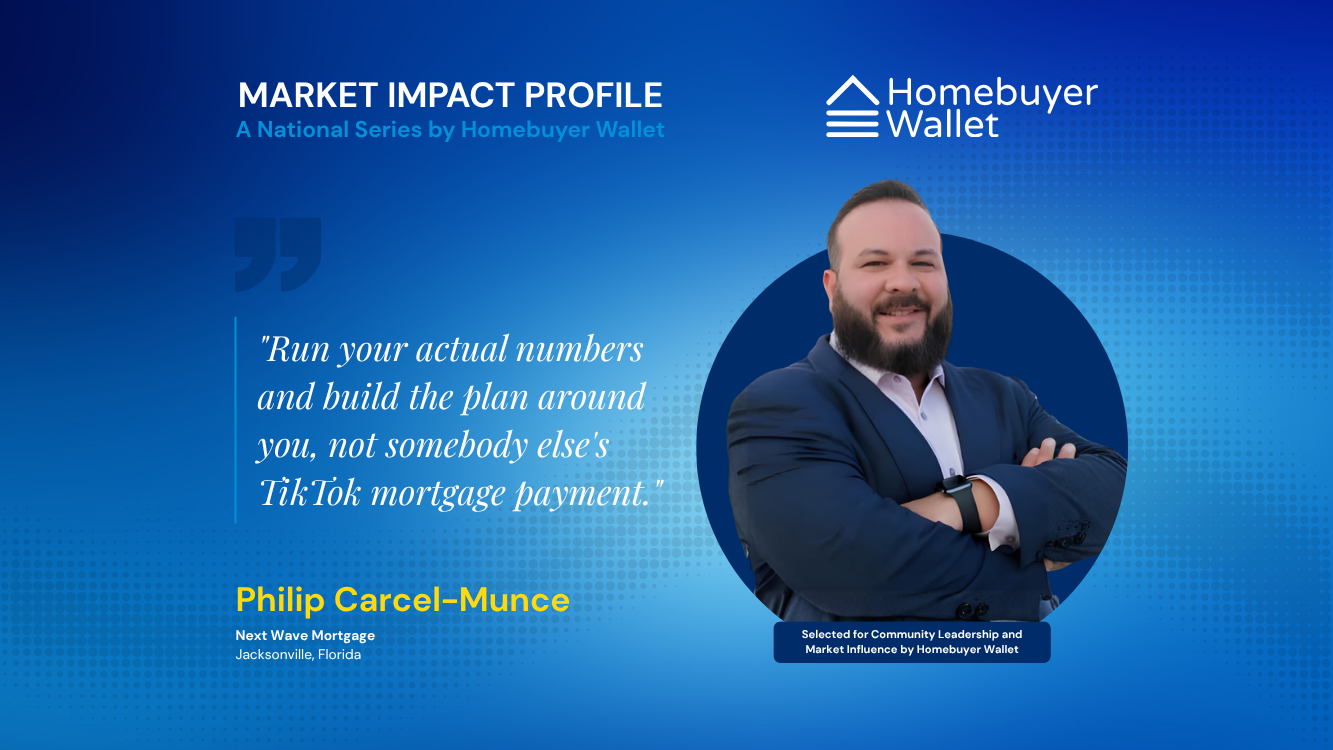
Next Wave Mortgage’s Philip Carcel Munce brings an advisor-first approach to buyers navigating Jacksonville, Florida, North Florida and Southeast Georgia.
Jacksonville, Florida, gives buyers more room to compare homes than it did during the pandemic-era frenzy, but Philip Carcel Munce does not treat that shift as permission to buy casually. In August 2026, Duval County had 3,057 active single-family homes for sale, about 3.4 months of supply, a median single-family sale price of $335,000 and a median 25 days on market. For Munce, Director of Southeast Originations at Next Wave Mortgage, those numbers describe a market with more options but not one where every neighborhood, property or buyer should follow the same financing strategy.
Munce’s approach starts with a principle he learned before he ever originated a mortgage. In B2B wireless and telecom sales, he worked with businesses on wireless service, Internet of Things technology and software solutions, an experience that taught him to “start with the problem instead of the product.” That habit now shapes how he works with borrowers across Jacksonville, North Florida and Southeast Georgia: understand the buyer’s finances, lifestyle, concerns and goals first, then build the mortgage around them.
Local mortgage expertise means connecting a buyer’s financing and total ownership costs to the specific Jacksonville neighborhood and property they are considering.
Problem-Solving Became the Foundation of the Mortgage Strategy
Mortgages were not entirely new territory when Munce changed careers. His mother worked as a wholesale mortgage underwriter, and he grew up with a broader family connection to the industry. When COVID-19 disrupted the economy, a friend joined a retail refinance company that helped employees become licensed, and Munce decided to move fully into mortgage lending.
What kept him there was not simply the mechanics of originating loans. Munce saw how much a knowledgeable loan officer could change the outlook for someone who assumed buying a home was out of reach. That realization matched the problem-solving approach he had already developed in his previous career.
“Great loan officers are advisors and problem-solvers, not order takers,” Munce said. “Any LO can take an application and spit out a rate quote.”
That distinction runs through his work today. Munce asks open-ended questions before recommending financing because he wants to understand what buyers are trying to accomplish, what worries them and what they want their life to look like after closing. He is particularly focused on the monthly payment a buyer considers comfortable, rather than treating the maximum payment a borrower can qualify for as the target.
“My approach is advisor first, salesperson second,” he said.
Jacksonville Offers More Than One Version of Homeownership
That consultative approach fits a market Munce describes as unusually varied. Jacksonville buyers can consider historic neighborhoods such as Riverside and Murray Hill, beach communities, newer suburban developments or areas that provide more land, all within the same metropolitan area. The choices can produce very different lifestyles without requiring a buyer to leave Northeast Florida.
For many of Munce’s Jacksonville-area owner-occupant buyers, the typical purchase range falls between about $275,000 and $450,000. A single-family home in the mid-$300,000s represents a common example, although the size, age and style of a property can change significantly depending on its neighborhood and distance from the urban core or beaches.
Those differences are why Munce resists treating citywide housing statistics as a complete buying strategy.
“Jacksonville isn’t one housing market,” he said. “Conditions can change pretty dramatically by neighborhood, price point and even property type, so don’t make your buying strategy based on a headline about the overall market.”
The variety also shapes why people choose the region. Buyers can remain within the Jacksonville metro while shifting among urban neighborhoods, beaches, suburbs and larger properties farther out. Munce also points to the city’s accessibility for trips toward Atlanta, South Florida and the mountains of North Carolina as part of its broader lifestyle appeal.
More Inventory Has Changed the Buyer’s Leverage
The increase in available homes has changed how Munce’s clients can approach their search. Compared with the ultra-competitive pandemic period, buyers now have more opportunity to compare properties, consider alternatives and, in some cases, negotiate terms that would have been harder to obtain several years earlier.
Munce does not interpret that shift as a universal buyer’s market. A property that has been listed long enough for the seller to reconsider the initial price or presentation may create room for negotiation, while a well-priced home in a desirable pocket can still move quickly. His strategy changes with the property rather than relying on the broader Jacksonville trend alone.
That distinction matters because Munce may look beyond a simple price reduction when evaluating an opportunity. On the right property, seller-paid closing costs or a temporary or permanent mortgage-rate buydown can provide more value to the borrower than reducing the sales price by the same dollar amount. The financing and negotiation strategy work together rather than operating as separate parts of the transaction.
For a typical financed purchase in his market, Munce expects a closing timeline of approximately 25 to 30 days, although the specific loan program, appraisal, title work and speed of documentation can change that timeline. Florida generally operates as a title and escrow closing state, with title companies commonly coordinating closings in Northeast Florida.
The Purchase Price Is Only the First Affordability Number
Munce’s local-market strategy becomes most concrete when buyers begin comparing individual homes. In Florida, two properties with the same asking price can produce noticeably different monthly payments because homeowners insurance, property taxes and HOA expenses vary from one property to another.
Insurance creates another layer of property-specific analysis. Florida’s exposure to hurricanes means the age and condition of a roof and other major systems can materially affect what a home costs to insure. Munce tells buyers to evaluate those expenses alongside the purchase price rather than assuming that two similarly priced properties represent equivalent financial choices.
A house with a newer roof, HVAC system and updated major components may cost slightly more upfront but leave the buyer in a stronger position after closing. That is why Munce does not begin by asking only how much a borrower can qualify for.
“One of the most important questions for me is what monthly payment actually feels comfortable,” he said. “That’s not necessarily the same thing as the maximum payment someone can qualify for.”
Once he has that number, Munce works backward. The home price, down payment, property taxes, insurance, mortgage insurance and HOA costs become parts of the same decision rather than isolated estimates.
The Buyers He Serves Rarely Fit One Mortgage Template
Munce works regularly with first-time buyers, veterans and self-employed borrowers, along with move-up purchasers and investors. He is particularly drawn to transactions in which income, savings or financing requires more analysis than a straightforward mortgage application.
His current pipeline reflects that complexity. Munce spends significant time with first-time buyers using assistance, veterans using VA financing, self-employed borrowers and households with multiple income sources. He describes many of them as buyers who do not fit the traditional “W2 & 20% down stereotype.”
That borrower mix reinforces his preference for showing multiple financing scenarios instead of defaulting to a 20% down assumption. Qualified VA borrowers may be eligible for 0% down, FHA financing commonly starts at 3.5% down, and certain conventional options may permit as little as 3% down for eligible borrowers. Munce also evaluates whether down-payment assistance changes the amount of cash a buyer needs to bring to closing.
The program itself is not his starting point. Munce first determines what the borrower qualifies for and what structure makes financial sense for that buyer, an approach that mirrors the problem-first philosophy he brought with him from his earlier career.
Early Planning Turns Local Knowledge Into a Buying Strategy
Munce would rather begin working with a buyer before a property creates a deadline. He encourages borrowers to start the mortgage conversation even when they are months away from buying, have concerns about their credit or are still building savings. That gives him time to evaluate income, credit, savings, payment goals and potential assistance before the buyer is trying to solve those issues while negotiating a purchase contract.
Sometimes that early review changes the buyer’s timeline entirely. Munce has seen people who assumed they were six months or a year away from buying discover that they were much closer once they understood their actual qualifications and available options.
The same approach shapes Munce’s role inside Next Wave Mortgage. Although he serves as Director of Southeast Originations, he remains an active producing loan officer because he does not want to lead other originators while becoming disconnected from winning clients, structuring difficult files and getting loans to the closing table. He describes himself as a “guideline nerd” who enjoys difficult scenarios and wants the loan officers around him to become stronger advisors and problem-solvers.
For Jacksonville buyers, that philosophy ultimately comes back to specificity. The city offers enough neighborhoods, property types and price points for buyers to shape a purchase around the way they want to live, but Munce believes the numbers have to be equally personal.
“Run your actual numbers and build the plan around you,” he said, “not somebody else’s TikTok mortgage payment.”
Want to connect with Philip? You can follow him on Instagram, Tiktok, Facebook, or send him an email directly.