
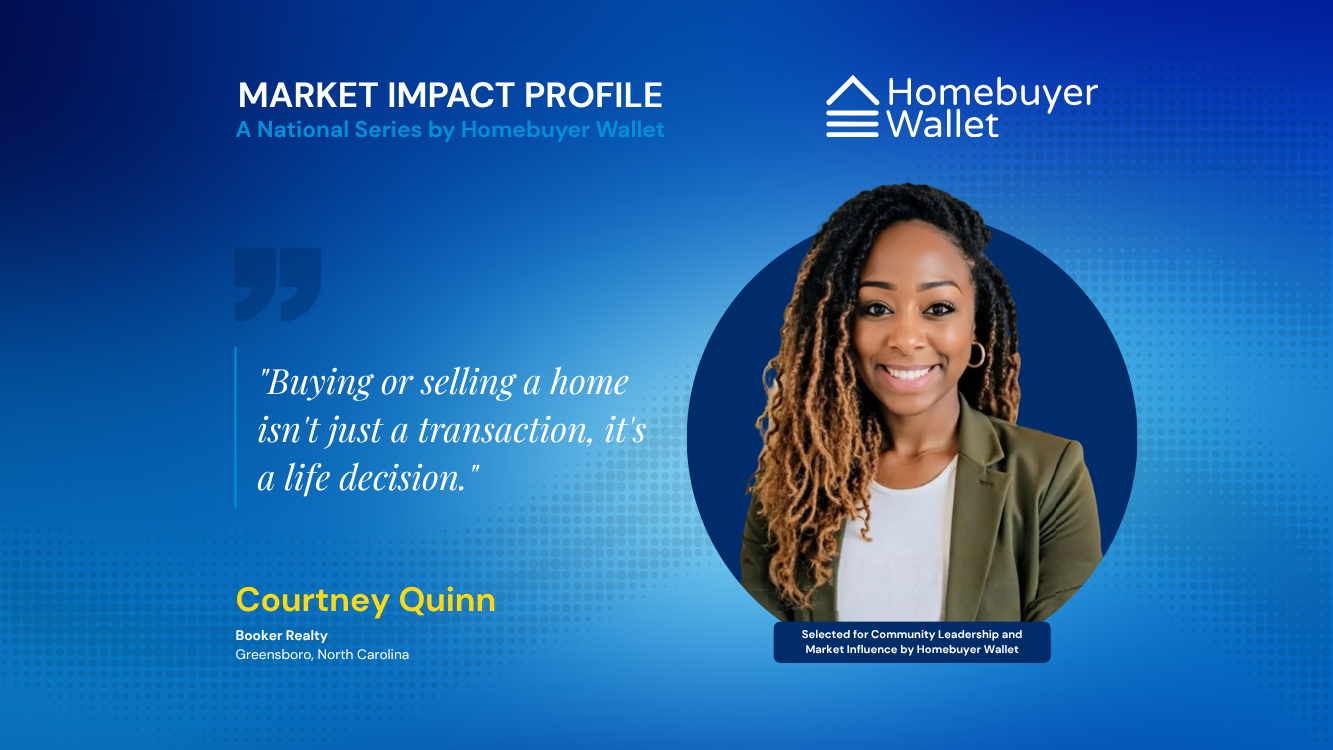
Courtney Suvoild Quinn brings a social worker’s listening-first approach to first-time homebuyers navigating Greensboro, North Carolina, and the broader Triad.
Before Courtney Suvoild Quinn became a Realtor with Booker Realty LLC, she spent her career helping families make high-stakes decisions as a social worker. She now brings that same emphasis on clarity, timing and long-term stability to first-time homebuyers in Greensboro, North Carolina, and across the Triad, where the buyers she has worked with have generally searched between $223,000 and $275,000. For Quinn, those numbers only begin the conversation because a buyer still has to determine whether the home, payment and location support the life they are trying to create. “Buying or selling a home isn’t just a transaction, it’s a life decision,” she said.
That perspective has particular meaning for Quinn as she builds her real estate career. She is in her first year as a Realtor, but her approach to working with people developed long before she entered the industry. Years spent guiding families through complicated circumstances taught her to look beyond an immediate decision and consider what will create stability over time. “I’m always prioritizing one’s long-term good over short-term gain,” she said.
Lifestyle-first real estate guidance means choosing a home according to the financial, geographic and personal life a buyer needs to sustain after the purchase.
High-Stakes Decisions Shaped the Work Before Real Estate
Quinn’s interest in real estate began from a personal place. While pregnant with her first child, she started thinking about how property ownership could help her build a financial legacy for her family. Her vision extended beyond owning a primary residence: She imagined eventually owning five or more properties in different countries and giving her children opportunities to experience other cultures, learn languages naturally and study abroad. Real estate represented freedom before it represented a profession.
She did not immediately pursue the industry. Instead, her career in social work — followed briefly by health and wellness coaching — gave her experience walking alongside people when the decisions in front of them carried consequences beyond the present moment. That background now shapes how she handles the uncertainty that can accompany a first home purchase. Her goal is not simply to move a buyer through a sequence of steps, but to help that person understand what those steps mean for the life that follows.
That distinction matters to Quinn because first-time buyers can enter the process focused on the destination while feeling overwhelmed by everything required to reach it. She pays particular attention to keeping buyers motivated as they make incremental financial progress, including working to improve their credit. She wants them to understand what lies ahead without allowing the entire process to become discouraging.
The Triad Search Starts Outside the Front Door
Quinn serves North Carolina’s Triad and surrounding areas, with her client experience so far centered on Greensboro. Her first-time buyers have typically searched in the $223,000-to-$275,000 range, and one representative property in that market is a roughly 1,650-square-foot single-family home.
Yet square footage and purchase price do not define the search for Quinn. When she describes what attracts buyers to the area, she returns to lifestyle: the time required to commute to work, confidence in a school for their children, access to grocery stores and farmers markets, a sense of safety and enough privacy to feel comfortable at home. Even landscaping can matter when it creates room for someone to step outside and unwind instead of feeling pressed against neighboring properties.
Those details shape the way she evaluates homes with clients. Rather than treating proximity as a secondary consideration after price and bedroom count, Quinn asks lifestyle questions and compares properties according to how well each one fits the buyer’s everyday needs. She sees location as something buyers will experience repeatedly long after closing, not simply a line on a listing sheet.
Listening Determines What the Buyer Actually Needs
Active listening sits at the center of Quinn’s client relationships. She deliberately tries to listen before moving immediately into the next task because she wants to understand what a buyer is communicating beneath the mechanics of the transaction. “I want my clients to feel heard and understood,” she said. “Care is the ultimate differentiator.”
Her approach reflects the relationship-building skills she developed before real estate. Quinn says people who refer her would likely describe her as warm and sweet, and she builds rapport by finding points of genuine connection and building on them as she learns more about the person in front of her. She also wants the experience to have some lightness, saying she enjoys laughing with people and wants them to feel good in her presence.
That warmth comes with an expectation of shared responsibility. Quinn does not view the buyer-agent relationship as one person pulling the other through the process. “I don’t chase people,” she said. “I partner with people who are prepared to participate.”
For first-time buyers, that participation can mean confronting financial tasks before falling in love with a property. It can mean improving credit, understanding the payment and staying engaged when preparation takes longer than expected. Quinn’s role is to keep the process understandable while making sure the buyer remains an active decision-maker.
Affordability Has to Survive the Monthly Payment
The financial side of a Triad home purchase reinforces Quinn’s emphasis on looking beyond the headline number. In her experience, buyers using FHA financing have been expected to make a 3.5% down payment. She estimates closing costs can run from about $8,000 to $15,000 depending on the buyer’s loan and financial situation, while a typical closing timeline is about 30 to 45 days.
Quinn sees another number as equally important: the monthly payment. She identifies one common mistake as focusing too heavily on the loan amount without giving enough attention to taxes and what the buyer will actually owe each month. That distinction fits directly into her broader philosophy because qualifying for a certain purchase price does not automatically mean the resulting housing expense aligns with the buyer’s life.
Her financing relationships support that approach. Quinn values working with a loan officer who is relationship-driven, knowledgeable and able to explore mortgage options based on the buyer’s individual circumstances. For her, the lender relationship is most useful when it helps translate a buyer’s financial position into a realistic path forward rather than reducing the conversation to a maximum approval figure.
North Carolina’s Collaborative Culture Fits the Service Model
Quinn’s connection to North Carolina also helps explain why she wants to build her career there. Originally from Washington state, she says she experienced networking there as more competitive. In North Carolina, she has been drawn to what she describes as Southern hospitality and a culture in which people appear more interested in genuine connection, collaboration and seeing others succeed.
That environment mirrors the kind of professional Quinn is trying to become. She has pushed herself to be more visible through in-person conversations, Facebook posts and social media videos even though her natural tendency can be to stay to herself. Her marketing philosophy centers on giving useful information first, including through teaching, webinars, classes and written content. “I want to be considered a person who is more concerned with helping rather than selling,” she said.
That focus also explains why she defines great agents by the experience they create rather than by visibility alone. Quinn believes strong agents know whom they serve, develop workable systems, take action and over-deliver for their clients. Her own version begins with listening closely enough to understand what success actually means to the person buying the home.
Building a Career Around the Lives Buyers Are Building
Quinn describes this stage of her career as a “becoming and building season.” For her, building a real estate business is unfolding alongside lessons from motherhood, leadership and the difference between wanting an outcome and becoming prepared to carry the responsibility that comes with it.
That language closely mirrors the way she thinks about homeownership. A buyer may initially focus on getting the keys, but Quinn is interested in what those keys unlock afterward: the commute they will make each morning, the neighborhood their family will return to each evening, the monthly obligation they must comfortably carry and the environment in which they will build their routines.
Her real estate career began with her own vision of using property to expand what was possible for her family. Now, as she works with first-time buyers in Greensboro and across North Carolina’s Triad, that same idea shapes the questions she asks on their behalf. The house matters, but Quinn’s work starts with something larger: understanding the life the buyer wants that house to support.
Want to connect with Courtney? You can follow her on Instagram, Tiktok, Facebook, or send her an email directly.