
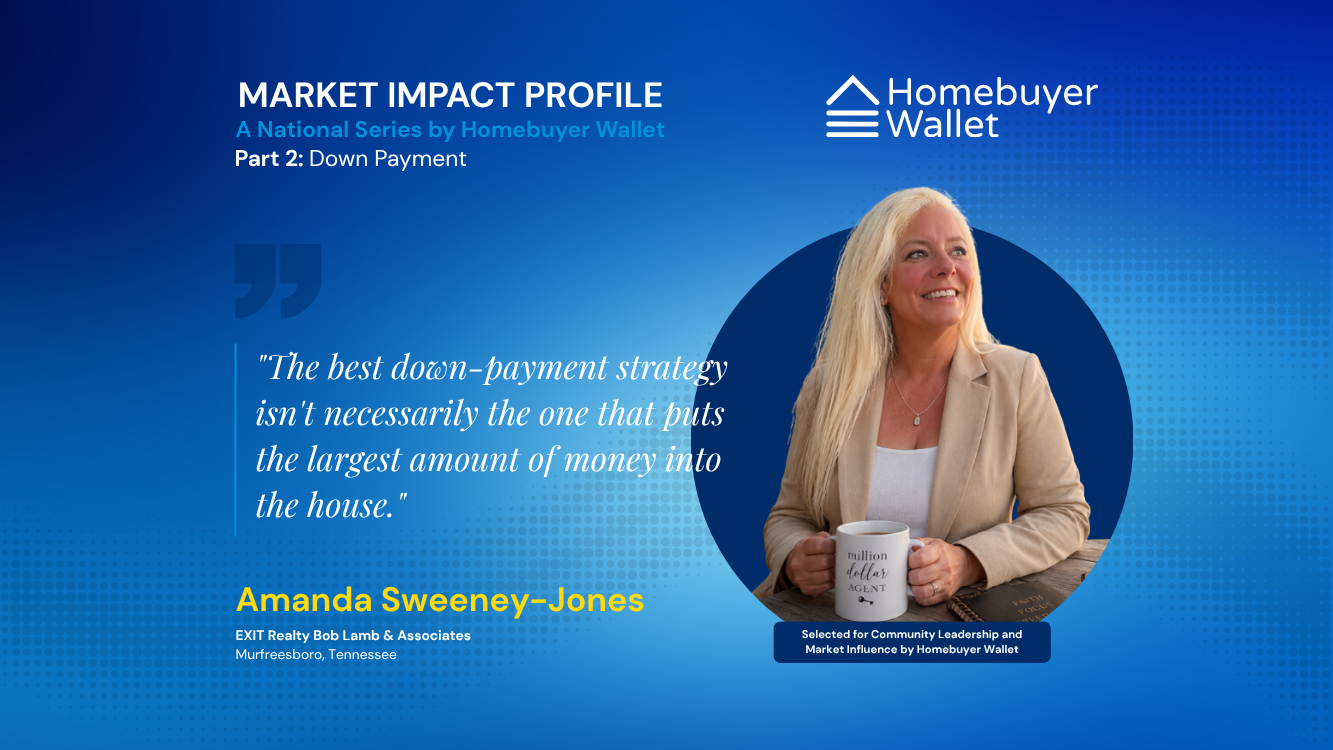
Realtor Amanda Sweeney-Jones helps buyers across Murfreesboro, Tennessee, and surrounding Middle Tennessee communities evaluate down payment assistance, loan options and total upfront costs before deciding how much cash belongs in a home purchase.
For buyers working with Amanda Sweeney-Jones in Murfreesboro, Tennessee, and surrounding communities across Rutherford and Cannon counties, the down payment is not treated as a fixed target. Her clients generally purchase from about $300,000 to $750,000-plus, and their financing can range from low- or no-down-payment options to putting down 5%, 10%, 20% or more. Sweeney-Jones starts with the buyer’s full financial picture rather than assuming that putting the most money possible into the house creates the strongest purchase.
That distinction matters because the down payment represents only part of the cash a buyer may need. Sweeney-Jones advises buyers to generally prepare for closing costs and prepaid expenses equal to approximately 2% to 5% of the purchase price, with the final amount affected by the loan, taxes, insurance, lender fees, points, title expenses and negotiated seller contributions. On a $450,000 purchase, that percentage alone represents roughly $9,000 to $22,500 before the buyer’s down payment is considered.
Cash at Closing Is a Strategy, Not a Single Number
Sweeney-Jones wants buyers discussing financing before they become committed to a particular house. She encourages them to connect with a lender early because the amount available for a down payment, the loan structure and the buyer’s other financial obligations can change what a sustainable purchase looks like.
“The best down-payment strategy isn’t necessarily the one that puts the largest amount of money into the house,” Sweeney-Jones said. That principle shapes how she approaches financing conversations: the objective is not automatically to maximize the down payment, but to determine how the buyer’s available resources fit into the complete transaction.
Her typical Middle Tennessee single-family purchase helps show why that decision can carry significant weight. Sweeney-Jones places a common three-bedroom, two- to three-bath home of approximately 1,800 to 2,500 square feet in the $400,000 to $550,000 range, which means even relatively small changes in down payment percentage can move tens of thousands of dollars into or out of the buyer’s upfront cash requirement.
Financing access is the process of structuring a purchase around the buyer’s full financial position rather than forcing every buyer into the same down payment or loan formula. For Sweeney-Jones, that means looking at available financing, potential assistance and cash-to-close requirements together before deciding which path fits the buyer.
Assistance Is One Tool Inside the Financing Plan
Sweeney-Jones works with buyers who may qualify for programs offered through the Tennessee Housing Development Agency, including the Great Choice Home Loan and down payment assistance options. Those resources become part of a broader financing review in which she and the lender also consider conventional, FHA, VA and other financing based on the buyer’s individual circumstances.
The benefit of that approach is not simply access to another loan product. Down payment assistance directly addresses one of the largest upfront portions of a purchase, while Sweeney-Jones’ wider financing review accounts for buyers whose required or preferred down payment may otherwise fall anywhere from a low- or no-down-payment structure to 20% or more. She uses the availability of assistance as one variable in the financial decision rather than as an automatic recommendation.
“I don’t believe in automatically steering every buyer toward the same program,” Sweeney-Jones said. “I prefer to have a knowledgeable lender look at the buyer’s complete financial picture and determine what options make sense.”
That choice keeps the financing conversation tied to the buyer instead of the product. A first-time buyer trying to limit upfront cash may need a different structure from a move-up buyer who has substantial equity available, even if both are shopping within the same Middle Tennessee price range.
The Financial Picture Comes Before the Loan Product
Sweeney-Jones’ process begins with understanding what the buyer is trying to accomplish and then bringing a lender into the conversation early enough to shape the search. The lender can evaluate the buyer’s qualifications and financing alternatives, while Sweeney-Jones keeps the real estate decision connected to the buyer’s price range, property goals and long-term plans.
“Every buyer’s situation is different, so I work closely with trusted lenders to identify the programs that best fit their goals,” she said. Her role is not to choose a loan for the buyer, but to make sure financing becomes part of the purchase strategy before a property creates emotional pressure to move forward.
That sequence also keeps the monthly payment visible alongside the cash required at closing. Sweeney-Jones gives the example of a $375,000 loan at 7% for 30 years, which produces approximately $2,495 per month in principal and interest before property taxes, homeowners insurance, mortgage insurance or homeowners association fees are added.
The numbers force two decisions to remain connected. A buyer has to determine not only how much cash can reasonably go into the transaction today, but also what the resulting financing structure means after closing.
That is why Sweeney-Jones resists treating a larger down payment as an automatic sign of a better purchase. Her strategy gives the buyer and lender room to compare what happens when cash is applied to the home against what the buyer may need for closing expenses and other financial priorities.
Upfront Costs Can Reshape a Typical Middle Tennessee Purchase
The mechanics become clearer within the price range Sweeney-Jones regularly sees. On a $400,000 home, her estimated 2% to 5% range for closing costs and prepaid expenses represents about $8,000 to $20,000; on a $550,000 purchase, the same range represents approximately $11,000 to $27,500. Those amounts come before adding whatever down payment the buyer’s financing requires or the buyer chooses to make.
A buyer putting 5% down on a $450,000 purchase, for example, would allocate $22,500 to the down payment before accounting for the additional closing-cost range. A 20% down payment on the same price would represent $90,000, illustrating why Sweeney-Jones wants the financing discussion to address more than a conventional assumption that more cash down is always the better move.
Her approach also leaves room for negotiated seller contributions to affect the final cash requirement. Sweeney-Jones includes those contributions among the factors that can change closing costs, making negotiation and financing parts of the same transaction rather than separate conversations.
She does not reduce the decision to finding the smallest possible down payment, either. Some buyers may benefit from putting more money into the property, while others may need the flexibility created by a lower-down-payment structure or assistance option. The decision turns on what the buyer can support across the entire purchase.
Education Keeps Financing From Becoming a Pressure Decision
The financing strategy reflects the broader way Sweeney-Jones works with buyers. She identifies education and protection as two of her primary responsibilities and deliberately slows the process when clients need more time to understand financing, inspections, repairs or resale implications.
“I never want someone wondering what’s happening or feeling pressured to make a decision they don’t fully understand,” she said. That conviction matters when financing choices can affect both the amount a buyer brings to closing and the monthly obligation that follows.
Sweeney-Jones applies the same standard when a financing option is technically available but may not fit what the buyer is trying to accomplish. Her philosophy is to measure success by whether clients feel informed and protected, even when that means spending additional time educating them or advising them to wait for a better opportunity.
That keeps the Tennessee Housing Development Agency’s Great Choice Home Loan and down payment assistance options in their proper place within her work. They are potential tools for qualified buyers, not conclusions reached before the buyer’s finances and goals have been evaluated.
For Sweeney-Jones, the pathway to homeownership begins by replacing a single question — how much can a buyer put down? — with a more complete one: how should this particular buyer structure the purchase? In a Middle Tennessee market where her clients may spend from roughly $300,000 to more than $750,000, that shift can change how much cash stays available, which financing options remain open and whether the buyer reaches the closing table with a structure that fits life after the purchase as carefully as the purchase itself.
Want to connect with Amanda? You can follow her on Instagram, Facebook, Tiktok or LinkedIn, visit her personal website for more details, or send her an email directly.